Review by Editor-in-Chief Rhiannon D’Averc – Show imagery by Maja Smiejkowska
Tare Isaac — TWIN by Tare

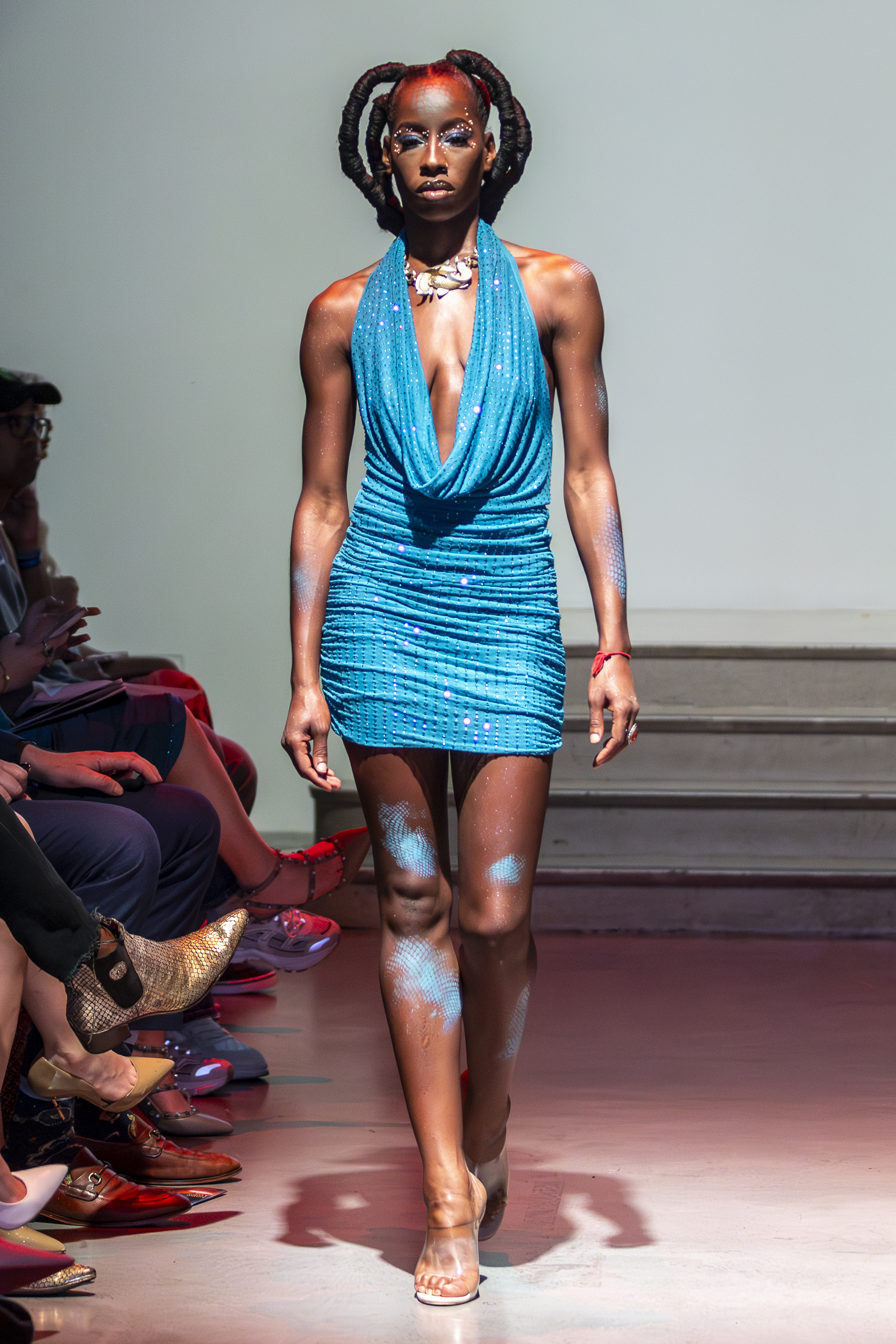
TWIN by Tare, the creation of Nigerian designer Tare Isaac who lives in the UK, finds its footing in the deep waters of Ijaw heritage. The SS26 chapter, The Water Bearers, is less a collection than a moving poem, weaving together themes of lineage, resilience, and femininity. Isaac channels water not only as metaphor but as methodology, the way fabric ripples on bias, the way light plays across bead studded nets, the way shells create audible rhythm with each step.
Craft is precise. Bias cut gowns move like currents, their seams invisible but intentional. Jewel lined hoods frame faces like veils of devotion, balancing intimacy with spectacle. Each bead is tied in a way that prevents entanglement, and drapes are cut to flow without collapse. There is a soft power here, garments whisper instead of shout, but their resonance is undeniable. Where others risk sentimentality with water metaphors, Isaac’s discipline grounds the idea in wearable structure.
The standout look was a sea blue gown, hooded and veiled with crystal lining. Twin cut outs at the waist modernized the silhouette while a concealed corset preserved line. Shell anklets brushed the floor with sound, waves meeting shore. This is ritual transformed into luxury eveningwear, a striking counterpoint to the louder maximalism of peers.
Isaac pushes cultural storytelling into contemporary glamour, suggesting that the runway itself can be a river. It is luxury rooted in heritage, modern gowns that feel at once intimate and ceremonial. With The Water Bearers, TWIN by Tare positions itself as a house of ritual poetry engineered for the global stage.
Olumide Oyewunmi — MIDETUSH

Olumide Oyewunmi’s MIDETUSH breathes life into streetwear by embedding it with Lagos heritage and London poise. The SS26 collection, AFEFE ATI ILA (air and stripes), captures the sensation of warm nights and restless energy, with silhouettes that invite movement but never lose control.
The jackets skim the body instead of clinging, cut with high armholes and dropped shoulders that allow air to pass freely. Stripes in orange, tan, and electric blue align perfectly across seams, a sign of technical diligence. Cowrie shells punctuate collars and cuffs, transforming casual details into cultural markers. Shorts are neatly hemmed and internally bound, proving that interiors were considered with as much care as exteriors.
The effect is ease engineered into luxury. The cowrie additions ensure that the collection is never generic, while the tailored shorts and boxy jackets offer relevance to a global streetwear audience. If anything, the shorts and jacket pairing risks ubiquity, but Oyewunmi differentiates with his colour language and cultural punctuation.
The standout look featured a three piece set in bold stripes, camp shirt, jacket, and tailored shorts, with cowrie tabs adorning the collar. The rhythm of the stripe echoed music, the look seemed to dance even when still. It was both Lagos night and London street, bridging continents seamlessly.
MIDETUSH reframes global streetwear through a distinctly West African lens. It positions Oyewunmi as a voice capable of shaping both the aesthetic and cultural conversations in fashion. The result is streetwear with a soul, light, rooted, and resonant.
Seyi Agboola — Itele

Itele reimagines the loafer as a cultural canvas. Seyi Agboola takes a classic British staple and infuses it with playful African symbolism, transforming what could be staid footwear into something witty, luminous, and proudly continental. His SS26 collection turns corporate seriousness into a medium for humor and critique.
The shoes gleamed under runway lights, embroidered with motifs of bees, currency stacks, and crest like badges. Each motif was sharp, satin stitched for sheen and precision. Between these louder statements, quieter designs featured rows of flush set silver studs, their sparkle understated yet commanding. Calfskin uppers were hand polished to a mirror finish, paired with Blake stitched soles for flexibility and durability. Toe boxes hovered between almond and square, giving a contemporary profile that appealed beyond traditionalists.
The collection works because it never lets play overwhelm craft. Even the most daring motifs are underpinned by meticulous construction. A risk remains in the boldness of iconography, which could limit everyday wear, but this is softened by the inclusion of more minimal options in the same last.
The hero piece was a black loafer embroidered with a bright yellow bee at the vamp, its wings detailed in metallic thread. Slim storm welts added definition while stacked heels finished in rubber ensured stability. It was a perfect meeting of levity and polish, seriousness undone by joy.
Itele makes a case for African footwear as a contender in the global luxury conversation. These shoes are not only witty statements but evidence of craftsmanship at the highest level. Agboola demonstrates that the loafer can become language, fluent in humor, heritage, and sophistication.
Ebimobowei Daukoru Ayah — AYAH

Ayah explores masculinity through ecology. His SS26 collection, The Fisherman’s Echo, reflects the resilience of life along the Niger Delta’s muddy rivers, places where survival depends on tide and toil. Ayah presents garments that feel silted with history but buoyant with endurance.
Relaxed silhouettes dominate, cut with care to suggest rhythm rather than lethargy. Wide leg trousers evoke the swell and retreat of tides, while kimono like coats billow with stillness, recalling nets waiting to be drawn. Fishnet overlays and cowrie threaded headpieces suggest scars of environmental trauma while simultaneously elevating the body into something priestly. The palette, grounded in earthy greens and browns, roots the collection in its source waters.
Dyed cottons evoke riverbeds, their uneven watermarks whispering of hidden life, while overlays are carefully bar tacked at stress points to ensure functionality. The dignity in these clothes lies in their contradiction, softness paired with grit. There is no sentimentality here, only endurance.
The defining look paired wide leg trousers in mud brown with a draped green kimono layered under a fishnet mesh laced with cowries. It read simultaneously as fisherman and water deity, mortal and myth. Movement created ripples of light and shadow, echoing water’s contradictions.
Ayah demonstrates that even polluted waters can produce beauty. His work positions African menswear beyond safari tropes, creating garments that carry cultural and ecological depth. The Fisherman’s Echo is a reminder that fashion can testify, that garments can be both wound and hymn.
Omobolanle Sulleman — Bola

Bola presents stillness as rebellion. Omobolanle Sulleman’s SS26 collection, Inheritance, reframes Ojude Oba festival dress as garments for lineage rather than costume. In doing so, she invites us to see clothes as heirlooms, threads binding mother to daughter, past to future.
The palette is a disciplined triad of navy, cornflower blue, and gold, covering each look in vertical stripes that carry symbolism of solemnity, joy, and reverence. Rendered in handwoven Aso Oke, these fabrics turn each garment into continuity, each look into moving heritage. The cuts are softly tailored, flattering without shouting, intended to live beyond a single trend cycle.
Restraint defines the presentation. Minimalist silhouettes and timeless tailoring might have risked quietness in a season of maximalism, but instead they read as intentional and powerful. The garments whisper but demand attention in their gravity.
The highlight was a cropped structured shirt with sculptural shoulders paired with a pleated full skirt in navy, cornflower, and gold stripes. The verticality of the garment extended the line of the body while the palette spoke of memory and reverence.
Bola demonstrates that true luxury lies not in novelty but in intentionality. This is a designer creating garments that become part of family stories, wearable artefacts meant to be treasured and passed down. In Inheritance, Sulleman has built a lineage on the runway.
Princess Mary Obeya, PEM

PEM’s SS26 collection, IRI OGRINIA, The Spirit Wears Red, was a jubilant invocation of Idoma heritage transformed for the global runway. Designer Princess Mary Obeya tapped into the potency of red as pulse, spirit, and bloodline, presenting a body of work that throbbed with rhythm and ritual while carrying the precision of contemporary craftsmanship.
Red dominated the runway not just as colour but as energy. Fabrics glowed in crimson, burgundy, and scarlet, each shade layered to suggest breath and heartbeat. Garments moved like living beings, dresses swayed, skirts flared, fringes shimmered, creating an atmosphere where culture was not static reference but kinetic choreography.
A standout was the backless gingham dress with a sculpted skirt that folded and opened like lungs in motion. The geometry of the skirt was engineered so that pleats unfolded rhythmically as the model walked, producing the illusion of dance even in stillness. Other pieces layered cowrie shells across seams, their placement not ornamental alone but functional, anchoring fringe and guiding movement. Beadwork was secured with hidden stays, proving Obeya’s insistence on durability despite exuberant motion.
The strength of the collection lay in its duality. Silhouettes were daringly modern, cropped bodices, open backs, sculpted skirts, yet they pulsed with ancestral codes. The cowries and beads were not added as nostalgic symbols but woven into the architecture of the garments, transforming heritage into literal structure. This allowed PEM to transcend costume, positioning Idoma language of dress as couture logic.
Obeya’s work thrived because it treated the runway as festival ground, a space where vitality and memory coexisted. IRI OGRINIA insisted that fashion could be both testimony and celebration. By reanimating Idoma ceremonial energy in contemporary silhouettes, PEM established itself as a brand that insists heritage is not past but pulse, alive, red, and resounding.
Lekan Taofeek Folarin, Lekan Aare

Lekan Aare’s SS26 menswear presentation was ceremonial suiting elevated to its most persuasive form. The name itself, meaning Homage of the King, set the tone for a collection that fused regality with meticulous tailoring, crafting garments that spoke as much to heritage as to modern pageantry.
Pinstripes dominated the runway, yet they were reimagined not as the language of boardrooms but as symbols of authority and lineage. The lines became insignia rather than pattern, carrying weight beyond surface decoration. A white suit with a single royal blue stripe flowing from shoulder to hem exemplified this ethos. The stripe, engineered like a sash, reframed tailoring as coronation, marking the wearer as sovereign in both presence and poise. Sleeves fanned into sculptural butterfly shapes, a daring yet elegant gesture that balanced the formality of the suit with expressive grace.
The construction was precise and deliberate. Pinstripes aligned flawlessly across seams and darts, a feat of technical discipline. Sleeves retained sculptural volume through subtle internal structuring, while piping melted seamlessly into the fabric, creating continuity rather than interruption. Every detail reinforced the collection’s intention, ensuring the grandeur never collapsed into spectacle.
The hero look, that white pinstripe suit with its single royal blue line, epitomized the collection’s vision. It embodied ceremony translated into modernity, a garment that felt equally at home in a throne room, gala, or contemporary runway. Its symbolism was powerful without excess, kingly yet wearable, heritage made aspirational.
Aare’s work arrived at a moment when menswear is hungry for grandeur and renewed ritual. His SS26 vision proved that suiting, reframed through Yoruba heritage and cultural reverence, can hold global relevance without losing specificity. Lekan Aare positioned himself not just as a tailor of garments but as a custodian of ceremonial masculinity, creating clothes that command presence, respect, and legacy.
Kolapo Omoyoloye, Kaypee Footwear

Kaypee Footwear’s SS26 collection, ÀPÁTA (Stone), treated shoes as artefacts of history, terrain, and memory. Designer Kolapo Omoyoloye approached footwear not as accessory but as archive, crafting loafers and mules that felt both unearthed from shrines and destined for contemporary streets. This was footwear as excavation, each piece carrying echoes of ancestry while insisting on modern wearability.
Vegetable tanned leather served as the foundation, hand dyed in ochres, yellows, and reds that recalled festival banners, warrior cloths, and sacred earth. These were not surface treatments alone but pigments absorbed into the leather, giving each shoe tonal depth and individuality. Motifs resembling footprints and pathways were hand painted across uppers with deliberate irregularity, a reminder that every journey is unique. Soles were constructed in Blake Rapid stitch, a technique chosen for both endurance and elegance, ensuring durability without sacrificing refinement.
The standout design was a loafer drenched in yellow and red, its saturated tones radiating ceremonial weight. This piece reminded the audience of journeys traced across land, rituals enacted in procession, and stories carried from one generation to the next. The tactility of the leather recalled goatskin drums and layered wrappers, rooting the shoes in sound and ceremony as much as in material.
What made Kaypee’s work compelling was its ability to embed ritual and lineage into shoes while preserving their daily functionality. These were statement pieces, yes, but they were engineered for wear, grounding fashion in the act of walking, moving, and journeying.
In ÀPÁTA, Kaypee Footwear reasserted that shoes can carry cultural dignity into global luxury spaces. They became memory, story, and anchor all at once, proving that the ground beneath our feet can be elevated into poetry when treated with reverence and craft.
Yusuf Kareem, Oomo Ajadi

Oomo Ajadi’s SS26 presentation transformed the runway into sacred procession. Inspired by the Ẹyọ masquerade of Lagos, designer Yusuf Kareem blurred the boundary between performance, ritual, and fashion, creating an atmosphere that felt more like a living archive than a conventional show. This was fashion as invocation, garments as spirit vessels.
Models emerged draped entirely in white, their faces veiled, their movements deliberate and ceremonial. One carried an opá staff, striking the ground with quiet rhythm, a gesture of authority and reverence that commanded silence in the room. The collection’s restraint was striking: no excess embellishment, no loud colour, only the purity of white and the dignity of silhouette.
The garments themselves were deceptively simple. Flowing robes skimmed the body with an ease that belied the technical skill behind their construction. Seams were hidden within folds, hems were weighted to ensure controlled flow, and layers of fabric were balanced to prevent collapse while still appearing ethereal. The decision to work entirely in white was both bold and risky — one misstep could have tipped into monotony. Instead, Kareem embraced absence as presence, using fabric as canvas for spirit rather than ornament.
The hero moment was a tiered agbada like robe, veiled and finished with cowries stitched carefully at intervals. It read simultaneously as mortal and divine, ghost and god. As the model moved, the cowries caught the light and whispered against the fabric, reinforcing the sense of ritual.
What lingered after the finale was not just the image of the clothes but the gravity of the procession itself. Kareem reminded his audience that fashion is not always spectacle — it can also be ceremony, memory, and reverence. With Oomo Ajadi, the runway became shrine, and the act of showing became an act of honoring.
Salami Oluwaseun, OBIREEN

OBIREEN’s SS26 presentation stood as a tribute to feminine sovereignty, drawing inspiration from Queen Idia of Benin and translating her strength into modern couture. Designer Salami Oluwaseun created a collection that balanced opulence with discipline, positioning women not only as muses but as rulers in their own right.
The palette was drenched in deep reds and burgundies, colours tied to the sacred coral beads of Benin heritage. These tones carried both ceremonial authority and emotional intensity, transforming the runway into a space of reverence. Fabrics ranged from satin to brocade, cut into gowns and separates that shimmered with regal weight while maintaining fluidity. Sweeping skirts expanded and contracted with movement, while fitted bodices ensured control, embodying the duality of softness and command.
The construction was meticulous. Seams were reinforced to support the weight of beadwork, hems were weighted to maintain elegance in stride, and proportions were balanced with precision to avoid overwhelming the body. Coral and bead detailing traced straps and necklines not as decoration but as protective charms, each placement intentional and symbolic.
The most striking piece was a deep crimson gown with a sculpted bodice and expansive layered skirt. Beaded straps shimmered like jewelry, catching the light with each turn. It was a garment that radiated majesty yet retained wearability, bridging ancestral regalia and contemporary couture.
OBIREEN’s success lay in its ability to transform cultural homage into garments that spoke fluently in the language of global luxury. Rather than treating heritage as embellishment, Oluwaseun wove it into structure, ensuring that the collection resonated beyond spectacle. Queen Idia’s spirit was not simply referenced but embodied, making OBIREEN’s SS26 offering both tribute and testament.
This was not just fashion — it was legacy stitched into form, a vision of womanhood as powerful, immovable, and eternal.
Nancy Chizubere Johnson Chiadadi, Zubere

Zubere’s SS26 collection, ULỌ NWAANYI (The Woman’s Homecoming), was a jubilant celebration of Igbo bridal heritage reinterpreted for the global runway. Designer Nancy Chizubere Johnson Chiadadi captured the vibrancy of the bride’s return to her family, infusing the garments with joy, dignity, and cultural authority. The result was a collection that danced between ritual and couture, uniting ancestral codes with contemporary presence.
Layered raffia dominated, cut into swinging skirts and sculpted bodices that moved like festival dancers. The material, often stiff and rustic, was handled with sophistication here, layered and weighted in a way that allowed for fluidity without collapse. Coral embellishments crowned necklines, sleeves, and hems, not as ornament but as symbols of fertility, prosperity, and protection. In a bold statement of identity, custom woven lion motifs appeared in the fabric, proclaiming strength and royalty without needing roar.
The standout ensemble featured a cropped raffia bodice paired with a tiered skirt, framed with coral beads across the neckline and sleeves. The woven lion motif on the skirt’s front panel transformed the garment into heraldry, a wearable crest of womanhood. It was festive and solemn at once, a garment as much about arrival as adornment.
What distinguished Johnson Chiadadi’s approach was her ability to elevate materials like raffia beyond their folkloric associations, recasting them as couture textiles. The garments were carefully engineered, raffia trimmed to prevent fraying, coral beads double knotted for security, and silhouettes structured with inner linings for comfort and longevity.
The collection succeeded because it did not merely costume the bride but exalted her. ULỌ NWAANYI insisted that the Igbo bride is not passive but radiant, joyful, and sovereign. Zubere’s SS26 vision proved that heritage, when rendered with this level of craftsmanship and intention, can stand shoulder to shoulder with the global luxury vocabulary while remaining unapologetically local in its heartbeat.
Motunrayo Yetunde Ajayi, Montunyaro

Montunyaro’s SS26 collection, Of Water and Spirit, was a luminous invocation of Oshun, the Yoruba river goddess, and the sacred rituals of the Osun Festival. Designer Motunrayo Yetunde Ajayi brought to the runway a body of work that shimmered with divinity, blurring the boundaries between sacred dress and high fashion. It was less a fashion show and more a spiritual performance, reminding the audience that clothing can sanctify as much as it can adorn.
Yellow dominated the palette, a direct reference to Oshun’s colour and her association with prosperity, love, and divine femininity. Gold fringes swayed with each step, beads cascaded across torsos, and headpieces rose like crowns of light. The garments were charged with energy, designed not only to be seen but to be felt, embodying dance, ritual, and prayer in motion.
The standout look was a golden headdress that cascaded down to the chest, paired with a bandeau top and tailored yellow trousers fringed with beaded layers. Each movement created a soundscape of beads clashing softly, turning the model’s walk into rhythm. This was less about spectacle and more about presence, the body as conduit of the divine.
Ajayi’s technical approach ensured that symbolism never overpowered structure. Fringes were graded by density to prevent weight from pulling seams, headdresses were internally wired for balance and comfort, and tailoring was interlined to hold shape against the fluidity of beads. This discipline kept the garments luminous but never chaotic, spiritual but wearable.
What set Montunyaro apart was the unapologetic embrace of spirituality as couture language. The collection carried the intimacy of prayer and the grandeur of festival, proving that sacred narratives can move seamlessly into global fashion contexts. Of Water and Spirit was both homage and offering, a reminder that design can channel divine light while still anchoring itself in precision and craft.
Olaitan Maria Olatoke, RBA (Robes and Blings by Akokomali)

RBA’s SS26 collection redefined bridalwear as coronation. Designer Olaitan Maria Olatoke presented a vision where the wedding morning was not a private ritual but a public enthronement, placing the bride at the center of cultural and spiritual power. Each look radiated with the authority of ceremony, transforming the runway into a stage of sovereignty.
The collection leaned heavily on coral and cowrie adornments, layered with such density that they shifted from ornament to armor. Full length robes and sculpted gowns were drenched in beadwork, their surfaces alive with light and texture. Cowries were arranged in symmetrical grids along hems and sleeves, while coral strands cascaded across bodices like royal sashes. The garments were not designed to merely beautify but to declare status and command reverence.
The crowning look was a regal gown encrusted with coral strands, paired with a towering headwrap that extended high above the model’s face. It felt less like fashion and more like enthronement, as though the bride was ascending her place in history. The gown was engineered with inner structures to bear the weight of the embellishment, while beadwork was reinforced at stress points to guarantee movement without collapse.
Olatoke’s achievement was in ensuring that such maximalism did not descend into chaos. Every garment was considered, every bead intentional, every line drawn from heritage into couture. The effect was overwhelming but disciplined, ceremonial yet wearable for its intended context.
With this collection, RBA repositioned African bridalwear as global couture, insisting that the bride is not a passive figure in white but a queen, radiant in coral and cowries. It was a bold reminder that marriage in many African traditions is not an ending but a coronation, and RBA captured that truth with precision and majesty.
Olutoba Odetomi, The Ideal Craftsmen

The Ideal Craftsmen’s SS26 collection, The Five, approached tailoring as quiet devotion, each look reading like an invocation of five orishas. Odetomi worked inside a language of restraint and ceremony, where familiar menswear forms carried symbolic charge, and a suit became less uniform and more vessel.
At first glance the collection seemed rooted in classic wardrobe pieces, jackets, trousers, coats. In Odetomi’s hands those staples became canvases for transformation. Bell sleeves were gently weighted so they swung with measured gravity. Shoulders were cut with a crisp, angular line that sharpened posture and suggested a ceremonial stance. The palette stayed disciplined, anchored in deep neutrals and luminous white, allowing silhouette and gesture to do the speaking rather than surface noise.
The craft rewarded close looking. Jackets were built on a light inner canvas that held shape while keeping the chest open and breathable. Sleeves were structured with discreet internal stays to maintain that sculptural flare without stiffness. Hardware and adornment were integrated with care, a blade motif mounted to the jacket through hidden anchor points inside the facing, and silver facial jewellery secured on a concealed harness so it sat cleanly on the face without strain. Closures were quiet, covered snaps and hook bars, so nothing disturbed the line.
The defining look paired a tailored jacket and trouser with the blade detail and a veil like arrangement of silver across the face. The figure sat between warrior and prophet, elevated but grounded, a man in a suit who had stepped into a charged space. An all white ensemble expanded the idea, draping around the body with monastic calm, like a futuristic cleric, proof that the collection could move from power to peace without losing coherence.
If any moment leaned toward theatre, the rigor of the make pulled it back to credibility. The result was menswear that remembered its roots in ceremony and status while speaking fluently to modern dressing. Odetomi showed that tailoring can still surprise, that a clean line can carry a prayer, and that symbolism, when engineered with precision, becomes presence rather than costume.


